Board Member Spotlight – M. Donald Kowitz
#OlderAmericanMonth
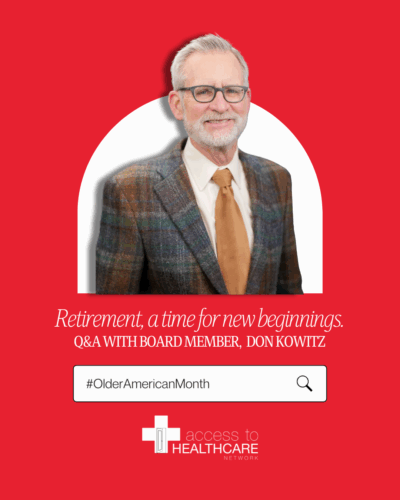 Don Kowitz, a distinguished retired senior executive with more than 30 years of experience in the healthcare and health insurance sectors, lends his expertise as the Chairperson of our board. In this informative Q&A, Don invites us into his world of retirement, encouraging us to see it not as a conclusion but as an exhilarating new chapter filled with potential. Join him as he shares vibrant insights and practical advice on how to navigate this transformative time, allowing us to unlock new adventures and a deeper appreciation for life beyond work.
How can you mentally prepare for the transition from a career-focused lifestyle to retirement?
From my perspective, it’s a bit like starting a new job, but one with significantly less pressure and responsibility. One important thing to remember is that you shouldn’t view retirement as a time when you won’t do anything. Instead, it represents a different phase in your life where you have more flexibility and freedom to choose how you spend your time.
For me, after leaving my career, I pursued some consulting work. Many people might want to stay involved in their field part-time. Of course, some retirees may think they want to play golf or engage in other leisure activities every day. While I enjoy those activities, I didn’t want to do them all the time. I valued the social connections and teamwork that come with a job, and I wanted to maintain that aspect of my life. That’s why I chose to do consulting for about ten years after retiring.
I encourage others to consider part-time work as well. I think it’s crucial for maintaining mental and emotional health to have activities and responsibilities to engage with. Work can provide those structures. Retirement gives you the opportunity to control the nature of your work. With consulting, I could select the projects I wanted to take on and avoid overcommitting myself. This level of flexibility is a significant advantage.
Additionally, I believe that getting involved in community service is another great way to stay active and engaged. I was already involved with a few organizations, such as Access to Healthcare Network, PBS and the Community Health Alliance, and these experiences help me stay connected and active, which I find to be very supportive.
What steps should I take to maintain or improve my mental and emotional health in retirement?
I believe it’s important to stay active in activities that interest you. Personally, after spending a lot of time in healthcare, I find it vital to engage in activities and remain connected with people in that field. Staying socially connected has been important for my well-being. By fostering these relationships and interests, you can significantly uplift your overall well-being and enrich your retirement experience.
How can I prevent boredom or a lack of purpose after retirement?
Personally, I haven’t felt bored at all. Retirement offers a lot of freedom to pursue the activities I enjoy, but it’s essential to actively engage in them.
For recreational activities, I enjoy golf, hiking, and skiing. I think it’s really important to stay active. Staying in touch with a few colleagues from my working years has also been valuable. Maintaining human contact is crucial, especially as I see many older adults struggling with loneliness and having a hard time keeping a social life.
I’ve never been a particularly social person, but I recognize the need for some social interaction. I go to the gym once a week. Before COVID, I used to go twice a week, but I adapted and discovered ways to work out at home during the pandemic. However, I still enjoy going to the gym because I’ve been going long enough to know people there, and it’s nice to have familiar faces to talk to while we stay active together.
As for hiking, I particularly enjoy exploring the Sierra. Being a former CPA, I keep a log of my hikes to track where I’ve been and how long each trail takes. Sometimes I think, “I don’t want to go back to a place I’ve already hiked,” but then I remember how enjoyable it was. I’ve tackled sections of the Tahoe Rim Trail, and altogether, I’ve completed about 70 to 90 of the 165 miles. I like hiking in those areas, and while I don’t do rock climbing, I enjoy climbing in the sense of challenging myself while hiking.
What health insurance or benefits should I review or adjust once I retire?
I definitely encourage retirees to understand Medicare, as there are many options available. Even for someone like me who has worked in the healthcare sector, it can be complicated. I often compare Medicare Advantage plans to traditional Medicare because they offer additional benefits.
It’s crucial for individuals to explore and understand their choices. If you plan to travel frequently, you might prefer regular Medicare, which allows you to access providers wherever you go within the United States.
I recommend seniors connect with local resources, such as the MAP program at Access to Healthcare, to help them understand their options. It’s an excellent resource that can make a big difference. Navigating these options can be somewhat complicated due to the numerous features involved, and it’s important to have a good grasp of them. Many people might also find the language used in healthcare confusing.
For example, just the other day, my wife needed to see a specialist and asked me whether she needed an authorization or a referral. I explained that those two terms refer to different things. A referral is provided by your doctor to see another specialist, while an authorization is the approval required from your insurance company for that visit. Understanding these distinctions is key, and you’re right—the terminology can be perplexing.
What advice can you give regarding financial preparedness for retirement?
That’s a good question! First and foremost, if possible, talk to a professional in the field. If you have a financial advisor or know someone in the industry, definitely reach out to them. As someone with a background in numbers—I’m a recovering CPA, though I don’t practice anymore—I can say that even I consult with a financial advisor regularly.
When preparing for retirement, consider maintaining a continued income source during the transition. Working part-time or doing consulting work can provide some financial support without solely relying on your savings and Social Security. This approach helps ease the pressure of transitioning into retirement, since you’ll still have some money coming in regularly. Personally, I feel fortunate to have income from consulting; it allows me to avoid touching my investments for a few years while still building up my finances.
Additionally, there are differing opinions on when to take Social Security. Some people may advise delaying it as long as possible to maximize payments. However, I believe that if you’re still working, you should take it at your full retirement age, which is currently 66 or possibly 67, depending on your birth year. While delaying can result in a higher monthly benefit, you must consider the “break-even” point—if you wait until 70, for instance, you need to live to at least 85 to truly benefit financially.
For context, my brother passed away suddenly at 70, which reinforces my belief in taking benefits when they’re available. You might find other resources suggesting you should wait for a higher payout, but that means missing out on a monthly check for years, and it may take a long time to make up that difference.
If you need to, you can begin taking Social Security as early as 62, but if you’re still working full-time, I recommend waiting. Let your benefits build up until you no longer have a full-time income. Once you quit working full-time, if you need the funds, then go ahead and start taking Social Security, but you might still consider working part-time to supplement your income.
Any other advice you can give to someone entering retirement?
When entering retirement, my advice is simple: just enjoy it. This is a time when you have the freedom to choose activities that you truly want to pursue. While it may not be entirely unrestricted, there are definitely broader opportunities available to you. I would encourage you to stay active, as this is crucial for maintaining both mental and physical health. Don’t let yourself become stagnant. So, my main takeaway is to enjoy this phase of life and stay engaged in activities that bring you joy.
Access to healthcare is here to assist you, whether you are in or transitioning into retirement, enrolling in Medicare, or just need to review your options and available resources.
The Nevada Care Connection (NVCC) and the Medicare Assistance Program (MAP) form our state’s established network of aging and disability resource centers. These programs are administered by Access to Healthcare Network (AHN) and serves as a single point of entry for assistance. It provides free information and resource navigation for long-term support services, as well as unbiased Medicare information and counseling for older adults, individuals with disabilities (of any age), family members, and caregivers.
CALL us today for FREE assistance at 877-861-1893.
Volunteer for The Northern Nevada Medicare Assistance Program (MAP)! MAP offers FREE training, flexible hours, mileage reimbursement, and the ability to empower, educate, and assist Medicare-eligible individuals, their families, and caregivers. To get started on your MAP certification, contact MAP’s Director at 775-284-1896 ext 802 Or Call Us Toll FREE at 1-844-826-2085.
Need a ride?
Access to Healthcare Network provides FREE non-emergent medical transportation for Senior Citizens, Disabled, and Low-Income Residents in Reno and the Greater Washoe County Area. Click here to learn more, or give us a call, 844-469-4933.